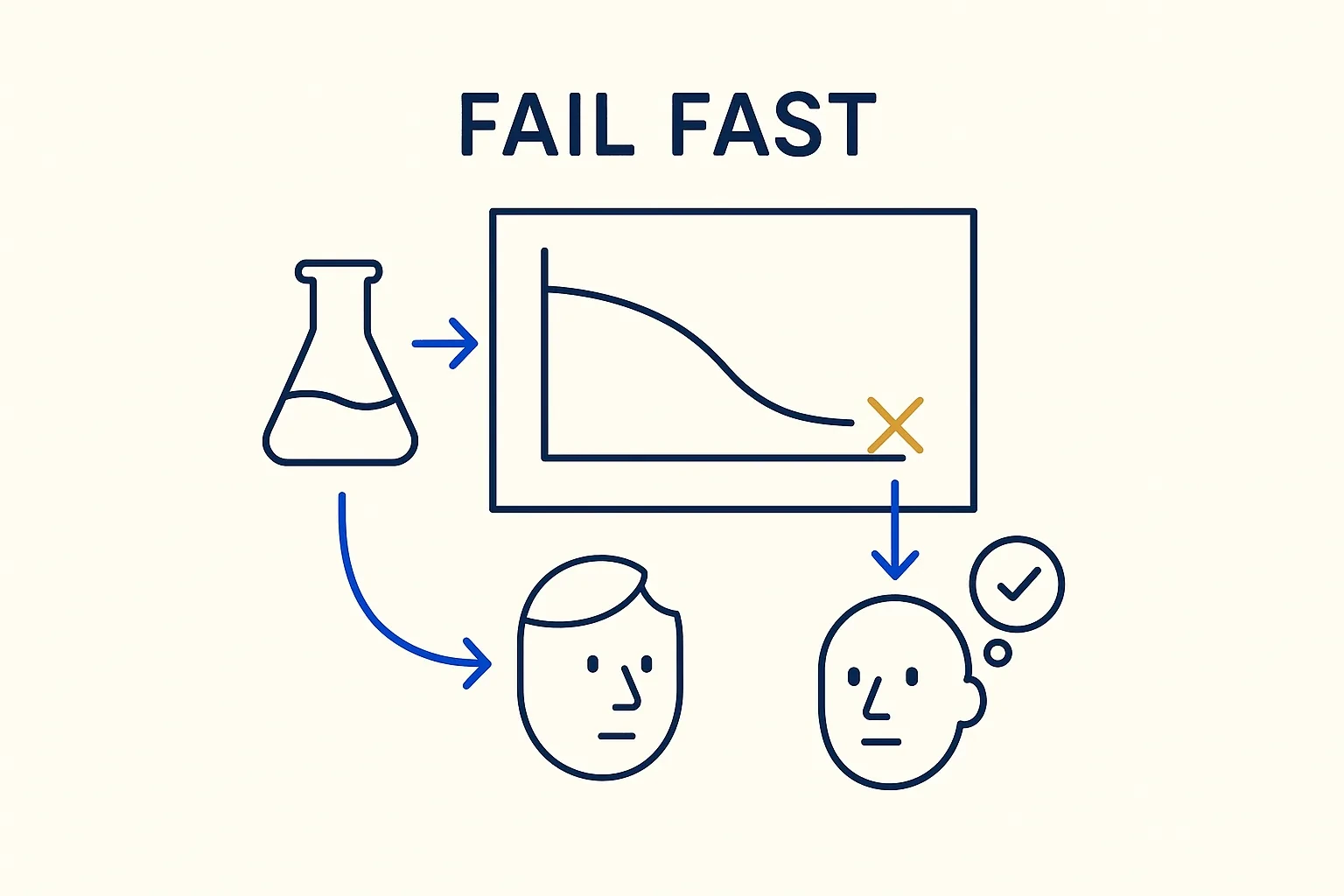
Fail fast is the discipline that makes experimentation actually pay off. The point isn’t to fail — it’s to find out quickly and cheaply whether an idea holds, so that when it doesn’t, you’ve lost hours instead of months. You design the experiment to give a clear signal early, you read that signal honestly, and then you decide: double down, or drop it. What you don’t do is keep polishing something that, deep down, you already suspect won’t work. The enemy is sunk cost. The longer you’ve invested in an approach, the harder it is to walk away — and that reluctance is exactly what turns a small, useful failure into an expensive, drawn-out one. Fail fast is permission to let go: because the experiment was cheap and quick by design, abandoning it costs almost nothing and frees you to try the next thing. With AI making experiments faster than ever, the ability to stop becomes as important as the ability to start. This is reality check and efficiency applied to your own ideas: confront the experiment with the facts, and don’t waste time on what the facts reject. Try quickly, learn quickly, quit quickly when you must — and spend the saved time on the experiment that works.
← All concepts & vocabulary