Why this is in my collection
From the publisher:
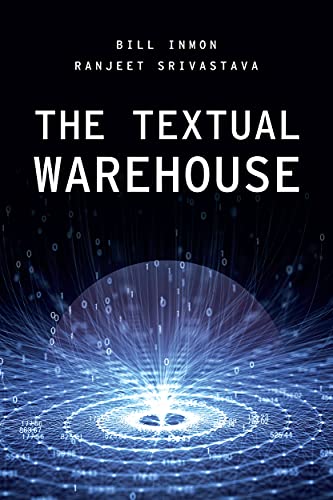
Build a Textual Warehouse to help your organization understand and analyze documents through text analytics (both sentiment and non-sentiment analysis), to make better business decisions. Learn the important role of documents and text within your organization, the difference between identifying and qualifying text, and when you need document preprocessing. Appreciate the power of taxonomies and the necessity of textual ETL. Know how the textual warehouse architecture differs from the conventional data warehouse architecture and when to apply contextualization and textual disambiguation.About B
Highlights
- Text deserves warehouse-grade architecture — Inmon extends the data warehouse discipline to documents: narrative text is most of an organization's information, and treating it with ad-hoc search instead of architecture wastes it; the same claim behind treating a markdown vault as a governed corpus, not a pile.
- Textual ETL turns narrative into queryable data — the core mechanism is transforming free text into structured, contextualized records; structurally identical to the vault→DuckDB pattern where files stay the source of truth and the database is the queryable view.
- Taxonomies do the heavy lifting — classification vocabularies are what let raw words resolve into business meaning, which makes taxonomies a rules layer: the forgotten third pillar sitting between the data and the AI.
- Context must be attached, not assumed — contextualization and disambiguation (whose "court": tennis or law?) show that words carry meaning only with surrounding metadata; the warrant for frontmatter-rich notes where context travels with the content.
- Identifying vs qualifying text — not all text is worth loading; deciding what qualifies before ingestion is a modelling decision, the MDDE reflex of designing the model before building the pipe.
- A different architecture, derived from the data's nature — the textual warehouse deliberately diverges from the conventional DW because the model of the data dictates the architecture, not the platform du jour.
- 2021 foreshadowing of the AI-context problem — Inmon specified what text needs to become machine-usable (structure, taxonomy, disambiguation) years before RAG made it urgent; the book reads today as a requirements document for feeding a knowledge vault to an LLM.
Highlights on this page are generated with the help of AI.