Why this is in my collection
From the publisher:
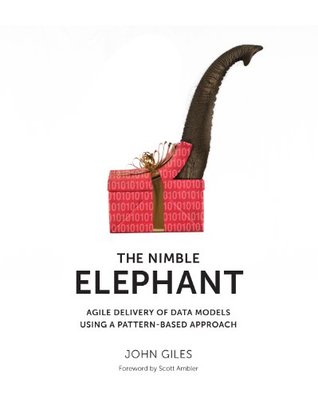
"Get it done well and get it done fast" are twin, apparently opposing, demands. Data architects are increasingly expected to deliver quality data models in challenging timeframes, and agile developers are increasingly expected to ensure that their solutions can be easily integrated with the data assets of the overall organization. If you need to deliver quality solutions despite exacting schedules, "The Nimble Elephant" will help by describing proven techniques that leverage the libraries of published data model patterns to rapidly assemble extensible and robust designs. The three sections in
Highlights
- Patterns dissolve the quality-versus-speed dilemma — Giles's answer to "done well and done fast" is that published data model patterns let you assemble proven structure quickly instead of choosing between rigor and deadline; the same wager MDDE makes at pipeline level.
- Assemble from the library, don't design from blank paper — the working method is to reach for Silverston- and Hay-style pattern libraries first and adapt, turning modeling from invention into informed selection; pattern reuse as the modeler's primary move.
- Patterns make models extensible by construction — a design assembled from generalization-aware patterns absorbs the requirements nobody mentioned yet, which is where the agility actually comes from — resilience is inherited from the pattern, not added later.
- Agile and data architecture need each other — developers get integration-safe schemas, architects get delivery cadence; the book is an early, concrete reconciliation of iterative delivery with enterprise data structure, years before that became mainstream.
- The elephant can dance if the choreography is reusable — big-enterprise modeling feels slow only when every engagement restarts from zero; a maintained pattern vocabulary is what converts experience into speed, the personal knowledge-compounding argument applied to a modeling career.
- Abstraction level is a delivery decision — choosing how generic to make a structure trades immediate readability against future change absorption, and Giles treats that trade-off explicitly rather than defaulting to either extreme.
Highlights on this page are generated with the help of AI.