Why this is in my collection
From the publisher:
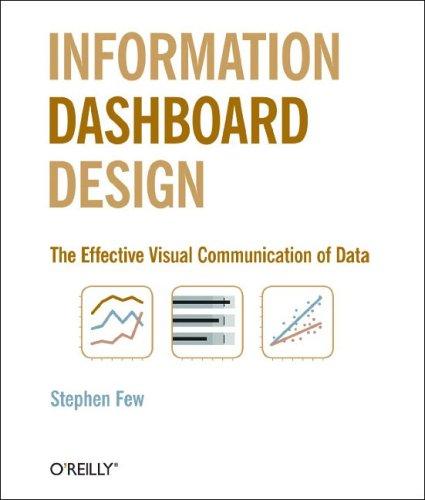
Dashboards have become popular in recent years as uniquely powerful tools for communicating important information at a glance. Although dashboards are potentially powerful, this potential is rarely realized. The greatest display technology in the world won't solve this if you fail to use effective visual design. And if a dashboard fails to tell you precisely what you need to know in an instant, you'll never use it, even if it's filled with cute gauges, meters, and traffic lights. Don't let your investment in dashboard technology go to waste. This book will teach you the visual design skills yo
Highlights
- A dashboard is a single-screen answer to a defined question — Few's definition disciplines the artifact before any pixel is drawn: at-a-glance monitoring of what matters for action; requirements-before-design applied to the display layer.
- Perception has rules, and design should obey them — preattentive attributes (position, length, color intensity) determine what the eye processes instantly; grounding visual choices in how vision works rather than in taste is rules-beat-decoration, the SBM argument at the glass.
- Non-data pixels are cost — the data-ink discipline inherited from Tufte: every gradient, border, and ornament that carries no information taxes the reader; distillation to essence as a design method, not a style preference.
- Gauges and traffic lights are catalogued anti-patterns — Few systematically dissects the vendor eye-candy that demos well and informs badly; a pattern-language of failure, which is as valuable as a pattern-language of success.
- Design the component once, reuse it everywhere — the bullet graph exists because Few engineered a replacement for the space-wasting gauge; solving a display problem at the pattern level instead of per-dashboard is the generation mindset applied to visualization.
- A number without context is noise — measures need comparisons (target, trend, prior period) to become information; the display-layer echo of the modeling truth that data means nothing without its relationships.
Highlights on this page are generated with the help of AI.