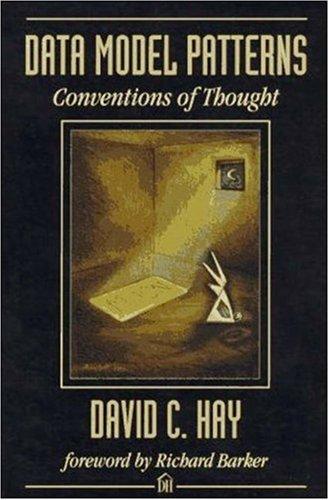
Why this is in my collection
Hay's 1995 classic makes a claim that was radical then and is still under-appreciated now: businesses are not as unique as they think, and the entity structures underneath them — parties, organizations, contracts, products, activities, accounts — recur so reliably that they can be catalogued as patterns. The subtitle is the real thesis: modeling patterns are conventions of thought, shared mental structures that let an analyst see through the surface vocabulary of an organization to the shape underneath. It is one of the oldest books in my collection and one of the least replaceable, a solid four-star favorite that predates almost everything else on this shelf.
It earns its place because it is the origin point of an idea my whole practice rests on: that data modeling is pattern recognition, not invention. Thirty years of modeling engagements have confirmed Hay's observation over and over — the client believes their domain is unique, and two workshops later we are looking at party/role/agreement structures Hay drew in 1995. A book that keeps being right for three decades about the deep structure of businesses is a reference work, whatever its publication date.
I also keep it as the historical anchor of the patterns lineage. Hay (and Silverston after him) established that reusable model patterns exist; Data Vault later standardized a structural pattern language; MDDE takes the next step and makes patterns executable. Owning the start of that chain matters when I argue about where the field is going.
Highlights
- Your business is not as unique as you think — the book's radical 1995 claim: the entity structures under organizations recur so reliably they can be catalogued; without this pattern density there would be nothing for model-driven generation to compile.
- A pattern is a convention of thought — not a template to copy but a shared abstraction that trains the analyst's eye; the modeler's advantage is seeing through an organization's surface vocabulary to the party/agreement/activity shape beneath it.
- Separate the party from the role it plays — customers, vendors, and employees are roles over the same underlying people and organizations; the pattern that untangles more client data messes than any other, and a direct ancestor of hub-and-link thinking in Data Vault.
- Contracts and agreements as first-class structure — Hay models the commitment itself (who agreed to what, for what consideration, over what period) rather than scattering it across order tables; agreements-as-entities is the shape reused from CRM designs to the vault's own agreements dossier.
- Abstraction level is a chosen position, not a discovery — the same domain drawn at several generalization levels shows that the modeler decides how general to be, and each choice trades precision for resilience; the dial every ensemble design turns.
- Activities, assets, and accounts complete the skeleton — beyond parties and contracts, Hay shows work-effort, physical-asset, and accounting structures recurring across industries, giving the modeler a near-complete starter skeleton for any enterprise.
- The seed of executable models — if models are predictable enough to catalogue in a book, they are predictable enough to standardize and eventually generate from; the 1995 origin of the chain that runs Hay → Data Vault → MDDE.
My application
Hay's patterns are in my hands in every modeling workshop: when a client describes their "unique" domain, I am silently mapping it onto party, contract, product, and activity structures — and the mapping almost always works. This book trained the reflex of seeing the convention beneath the customization, which is what lets me model fast without modeling shallow. It's the same conviction behind modern logical-model-first, model-driven tooling.
It is also a foundation stone under MDDE's generation thesis. Generation only pays off because models are pattern-dense — if every model were truly unique, there would be nothing to generate from. Hay proved the pattern density of business reality decades before anyone tried to compile it; when I write about why model-driven generation works at all, this is the deepest citation in the stack.
Key ideas worth citing
- Business data structures recur across industries: parties, organizations, products, contracts, activities, and accounts form a small stable catalogue underneath superficially different businesses.
- Modeling patterns are "conventions of thought" — shared abstractions that let analysts see an organization's structure more clearly than people who have worked there for years.
- Knowing a modeling notation is not the same as being able to model; the skill is recognizing which pattern the situation in front of you is an instance of.
- Generalization has a dial: Hay shows the same domain modeled at different abstraction levels, and choosing the level is itself the design decision.
- If patterns recur, models are partially predictable — the 1995 seed of the idea that model-driven artifacts can be standardized and, eventually, generated.
Related
- → concept: model-driven-data-engineering (pattern density is why generation works)
- → concept: data-modeling-patterns
- → concept: structure-beats-magic (conventions of thought = structure over improvisation)
- → article: your business is not as unique as you think (candidate)
Highlights on this page are generated with the help of AI.